Apartment Vending Houston · Published October 11, 2026
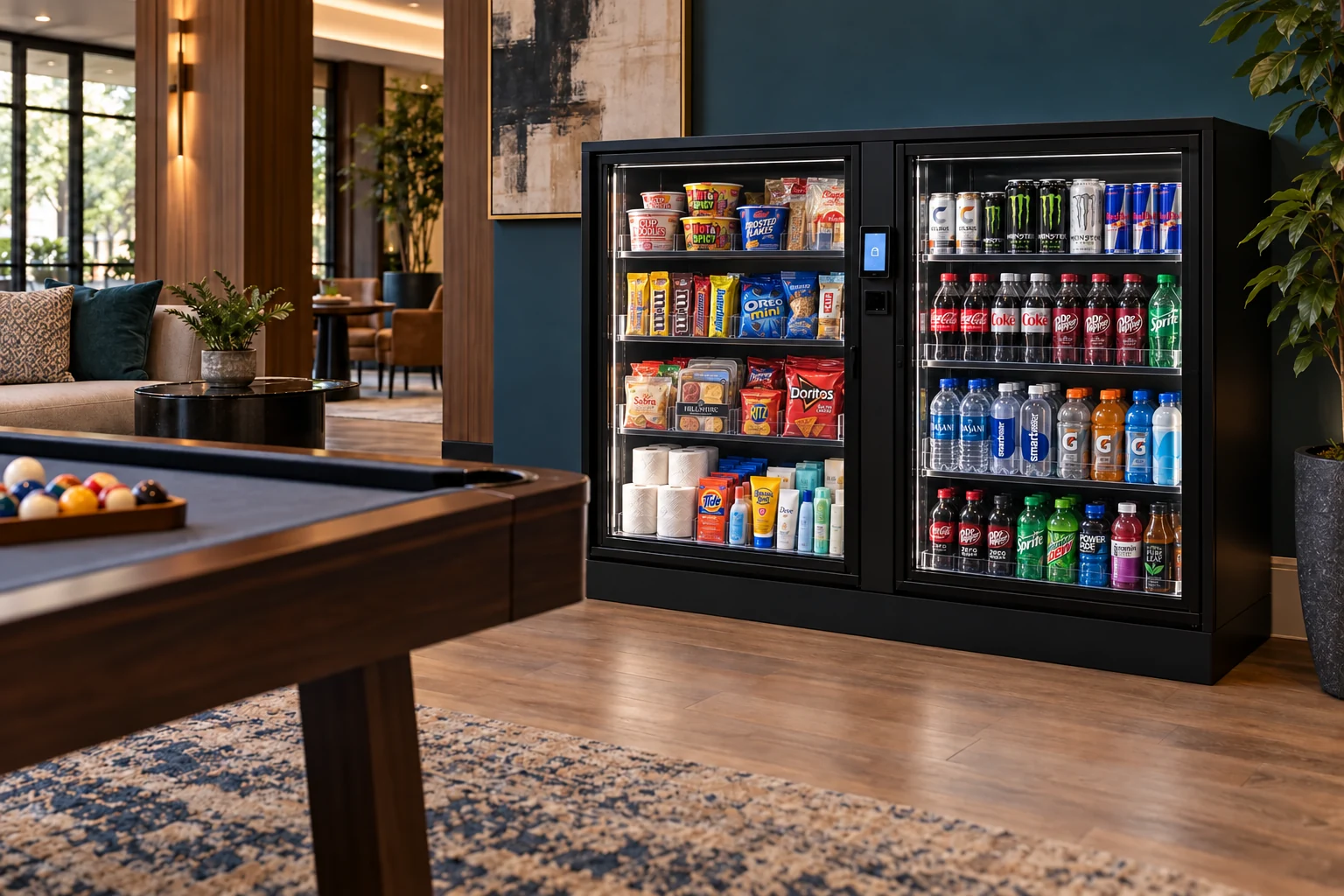
A smart cooler offers enclosed, cashless self-service purchasing with a format that can accommodate refreshments and suitable compact essentials. Traditional vending typically dispenses products through a delivery compartment. The best fit depends on the model, assortment, location and service plan—not the technology label alone.
IN THIS GUIDE
What is the difference between a smart cooler and a vending machine?
With a smart cooler, residents follow the payment and access instructions at the equipment, choose products from the enclosed unit and complete a cashless purchase through that model’s system. The precise steps, supported payment methods and purchase identification vary by equipment.
A traditional vending machine commonly asks the customer to select an item that the machine dispenses. Models vary considerably: some accept cashless payment, and some provide refrigerated products. Cashless payment alone does not make a unit a smart cooler.
Apartment Vending Houston specializes in enclosed smart amenities. The service recommendation focuses on resident convenience, a polished appearance, appropriate product storage and managed stocking.
Compare the details that matter to your apartment community
| Consideration | Enclosed smart cooler | Traditional vending machine |
|---|---|---|
| Purchasing | Access and product selection follow the model’s cashless workflow. | Residents select a product for dispensing; payment options depend on the model. |
| Product fit | Shelf layout and storage conditions determine the suitable assortment. | Product shape, dimensions and dispensing mechanism influence selection. |
| Everyday essentials | Suitable compact sealed necessities can be planned alongside refreshments. | Some necessities may fit; suitability depends on the specific dispensing setup. |
| Appearance | Single, double, freezer and discreet low-profile options can be assessed. | Dimensions and finishes vary; evaluate the actual machine. |
| Resident access | Follows the community’s rules for the chosen room or location. | Also follows the community’s access rules. |
| Service quality | Depends on stocking, communication, equipment care and support. | Also depends on the operator’s service plan. |
Plan for more than snacks and drinks
A residential amenity has a different purpose from a workplace snack stop. Residents may need a last-minute laundry product, a wrapped toilet-paper roll, sunscreen before the pool, a drink after a workout or a packaged bite to eat.
The equipment and assortment must work together. Chilled products require appropriate refrigeration; frozen products require a suitable freezer. Household and personal-care items must be sealed and compatible with their designated storage conditions. A low-profile setup can accommodate chilled refreshments and suitable ambient products when its compartments and configuration support that mix.
These details make the resident-essentials assortment more useful without assuming every product belongs in every cooler. Product availability and the agreed storage arrangement determine what is offered.
Choose the format for the community space
In a Downtown or Uptown/Galleria tower, equipment height, lobby sightlines and the elevator delivery route may shape the recommendation. In a Midtown or Montrose community, a shared lounge or mailroom may offer a useful daily stop. Each property is reviewed individually rather than assigned a standard neighborhood layout.
A single cooler may suit a narrower indoor space. A double cooler may offer more assortment where there is room and demand. A freezer adds a different storage category, while a shorter, discreet model may better complement a furnished lounge. Exact dimensions and infrastructure requirements are confirmed for the selected model.
Start with community placement options, then consider resident routes, available access hours, accessible circulation and stocking entry. Neither format creates access to a locked room or guarantees that a needed item will always be stocked.
The service plan matters as much as the equipment
A premium amenity needs ongoing care. Apartment Vending Houston schedules restocking at least weekly, manages the product mix and uses remote monitoring to help guide service. Residents have a direct support route for purchase questions; your leasing team does not become the inventory operator.
Ask who handles stocking, product feedback, service issues and support before comparing proposals. Also review costs and revenue-share terms, because similar-looking equipment can come with different property responsibilities.
A closer option when an errand can wait
When the needed product is stocked and the amenity is accessible, residents can make a purchase inside their community instead of leaving after dark or in bad weather. This is a practical convenience and peace-of-mind benefit, rather than a guarantee of personal security.
A site review connects these considerations to your actual property. Use the installation planning guide to gather the details that will help.
Turn the details into a plan for your property.
Share your community, approximate unit count and potential location. A site review helps you understand fit, responsibilities and the next step.
Book a Site Review